It was just announced that Brian Wilson of the Beach Boys has died aged 82.
He had started this band with his brothers and friends in the late 50s. I know only some of their songs. I don’t know the band well but by all accounts, he was a musical genius and the Beach Boys were big in the US. When I was reading the book, The Wrecking Crew, all the top session musicians of that era were in awe of him. His musical creativity, arrangements and song writing skills were top class. The Beach Boys were big before the Beatles were known in America.
He was so mesmerized by Be My Baby and the Phil Spector wall of sound technique that he wanted to create a masterpiece. And that album Pet Sounds, was so admired for its creativity that the Beatles modelled Sgt Pepper’s after that album.
Of course in later years drug use destroyed him and the band. They completely disappeared from the scene except for one hit Kokomo in the 80s. Such a pity.
This is something we all learn in primary school. Green plants absorb carbon dioxide from the atmosphere and with water they absorb from the soil via their roots, they use sunlight to convert these 3 items into sugars and release oxygen. We need both the oxygen and the sugars to live. It is something we all take for granted because it is so ubiquitous.
But last night I was reading a book on the origins of life and there was a chapter on photosynthesis. Then I realized how complex this process actually is. It has baffled scientists over the years who have been trying to understand this process and work out the exact manner by which this is done. Even today, the detailed process by which sugars are created from sunlight, water and carbon dioxide with the release of oxygen is not understood. Much work has been done in this field because if this process can be relicated, then we can set up factories to make sugars and do the conversion ourselves without having to rely on living plants and trees to sustain humans.
But photosynthesis was essential for the creation of life as we know it because without sufficient oxygen we may not exist. Without sugars we will also die, albeit a bit later. And if all the carbon dioxide we exhale is not converted into oxygen, we will also die.
We rely on the sugars created by photosynthesis as our nutrition to live. All the plants, fruits and animals we eat all have consumed the sugars from photosynthesis. These eventually become food for us.
It is incredible to imagine how these green chlorophyll organisms somehow were created early on in the history of earth which led to the oxygenation of our planet and to give rise to life as we know it on land. And the proportion of oxygen in the atmosphere has to be just right because too much oxygen is poisonous and will kill us off. Green plants and trees maintain that balance for us to be able to live.
The more I read I begin to wonder if the creation of humans was purely fortuitous or by some divine stroke. The number of things that had to be there in the right time, place and proportions for life to exist is just mind boggling!
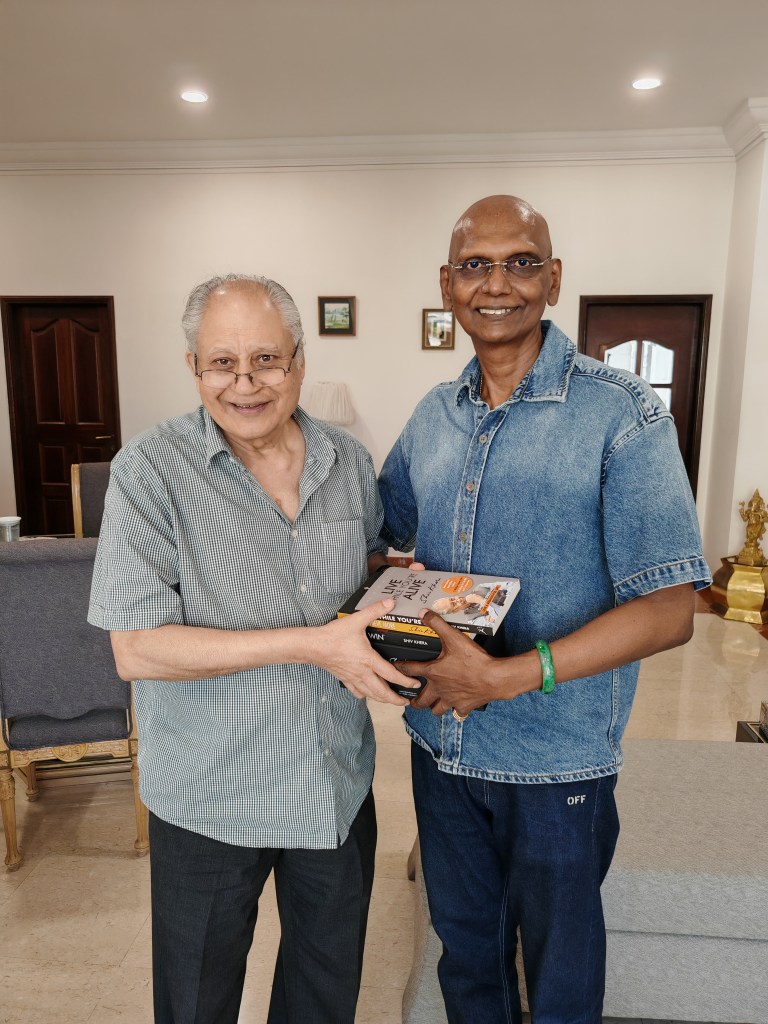
I met Shiv yesterday. Chris Loo, my Club 100 committee member, was invited to Shiv’s book launch, heard him speak and was impressed with him. Chris asked if we could have him as a speaker at our Club 100 gathering..
So at short notice I arranged to meet him at his Singapore home in Tanjong Rhu.
He is in his 70s and still strong and active. A pleasant gentleman. He is a well known motivational speaker. He has done business leadership and motivation talks and seminars for top organisations in the US and India. He counts some of the top companies in the world as his clients. He has also written 3 best selling books, each selling more than 10 million copies and published by Bloomsbury. We spent a pleasant hour talking. And we discussed to what kind of an audience he can be most effective.
He presented me with his books, which I am looking forward to reading. I now need to think about how I can use him effectively to reach out and help people in meaningful way!
I just started reading this book, What’s Gotten Into You by Dan Levitt. This book is about what we as humans are made up of and from where what we are made up of came from. As they say, we are made of star dust.
We are primarily composed of cells and atoms. Now every one knows and accepts this. The different chemical compounds in us makes us what we are all of which are combinations of elements.
This book is a fascinating study of how atoms were discovered. We think of atoms as the smallest known particles, but it is not the case. The books traces the discovery of what makes up atoms, the birth of the universe, the first simplest element that existed, which is hydrogen, and how from hydrogen all the other elements were formed.
Anyway I digress. I have not completed reading this book yet.
This book discusses many of the early pioneers in the field of astronomy, physics and quantum physics such as Rutherford, Einstein, Bohr and Boyle. There is also a section on Cecilia Payne. She was one of the earliest physicist and it was she who discovered that it has to be from the stars where all the other elements were created. She first noted that the earliest stars were only comprised of hydrogen and helium. Somehow from there, these elements combined to create the heavier elements.
But when she was in secondary school and before she got her scholarship to go to Cambridge, her school choirmaster was Gustav Holst, the famed composer of the Planets! Imagine having a world famous composer as your school music teacher. His music from Jupiter has been played at funerals for the royals and Winston Churchill. Can you imagine 2 famous personalities in the same secondary school. One as a music teacher and the other a student. She must have also been a good musician because Holst urged her to become a musician!
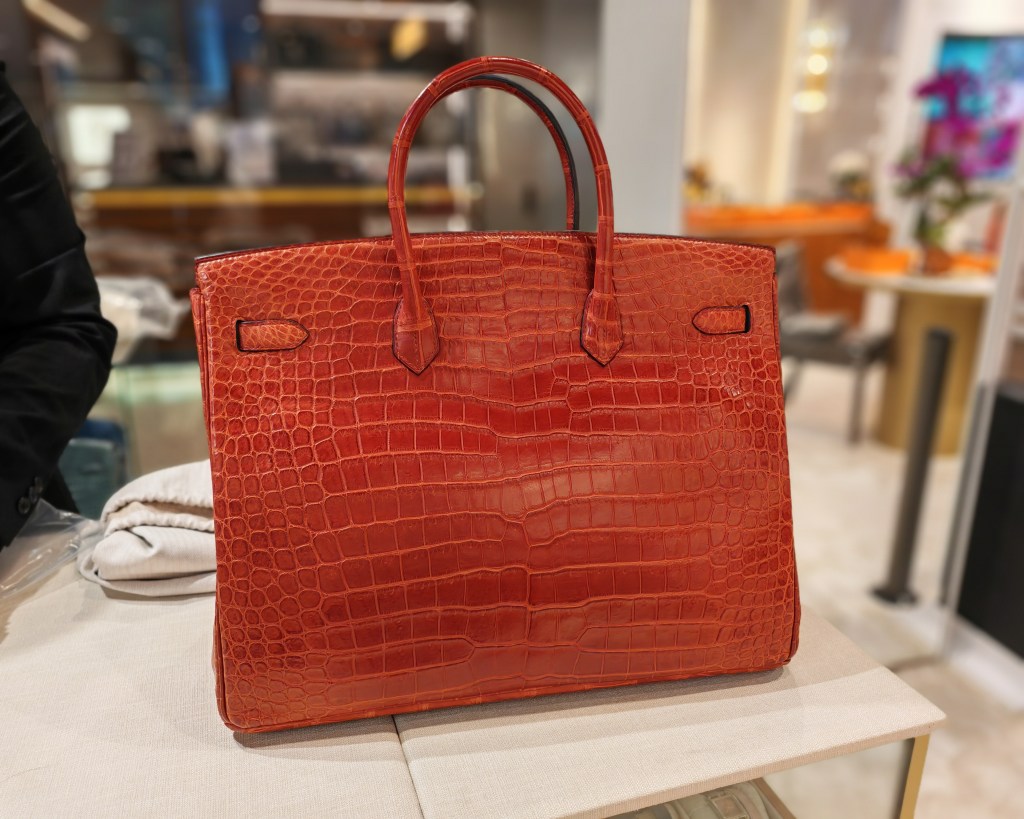
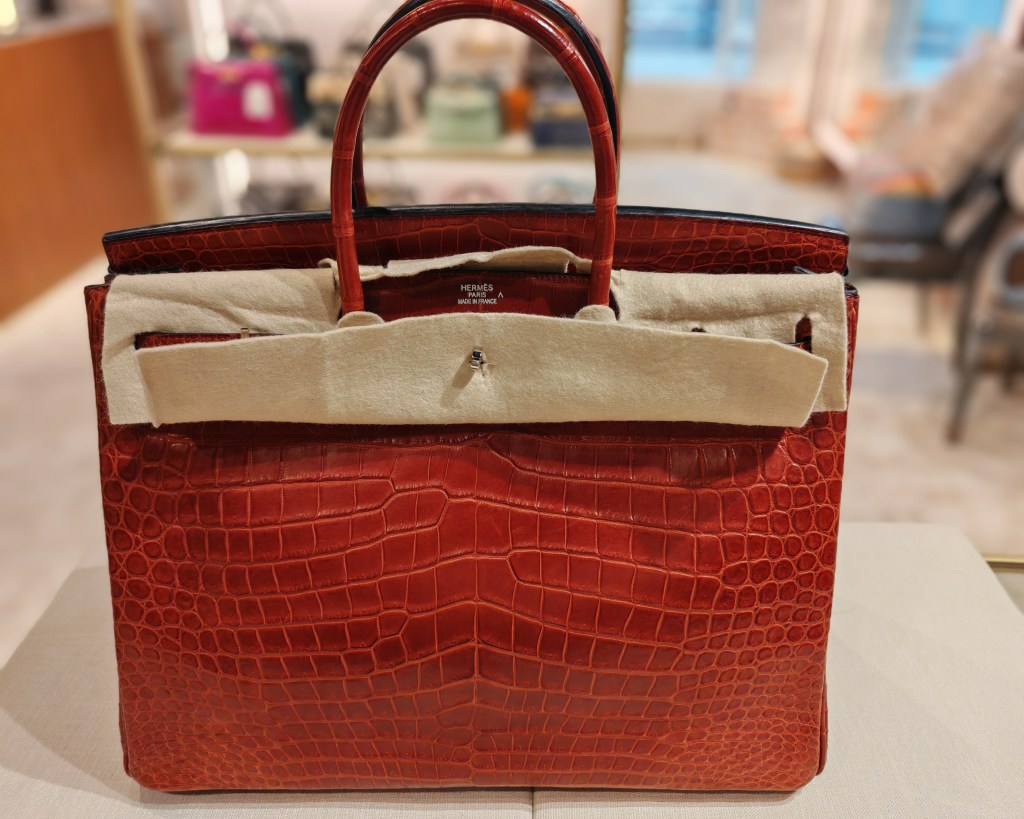
I decided to indulge myself recently and purchased a used Birkin 40 in porosus crocodile skin.
I have purchased Hermes bags for myself before. I first purchased a large sized jypsiere. I found it too heavy on my shoulders as it’s a shoulder bag. I then decided to try a medium sized jypsiere. That didn’t work too and it was still too heavy on my shoulders.
I prefer to carry my bags, not shoulder strap it.
So I came across this bag. It was in good condition with all the paperwork and as a bonus, in crocodile skin. And the size 40 is perfect for guys. The 25, 30 and 35 are too small for me. Women will not carry a 40 and even for guys you need someone with height to be able to carry off a 40.
Strangely in 1984, when Jane Birkin first asked the Hermes CEO to create a bag that she could use as a daily bag to carry all her things, thus giving rise to the birth of the Birkin, her bag was a size 40.
I now just need to find the right occasion to carry this bag!
I just finished watching this Netflix drama series. It’s a 9 part drama series set in Scotland.
A well written and captivating series. Kept me on my toes till the end. Unlike US dramas, it doesn’t depend on the characters being flashy or good looking. This featured very down to earth characters and not all of the likeable. Each with their own faults. I didn’t recognize a single actor. The screenplay was tight and intelligent.
The series is a police drama where not all loose ends were neatly tied up in the end. And although it was a 9 episode storyline, each about an hour long, it didn’t feel draggy.
It is possible they can do a follow up and they may well do so because of the very good reviews this show has received. If they do, I hope they come up with an equally compelling storyline so as not to spoil the memory of the first series.
An annual event at the Shangri la involving defence personalities which has now become an established calendar event.
It’s good that a small country like Singapore can be a host to such a large important gathering of importing people around the world to discuss regional defence and cooperation.
47 countries are represented, mostly with their defence ministers or head of armies. Malaysia is represented by its PM and France sent it’s President. US is well represented with their Secretary of State for Defense and all their regional military heads.
China sent only a Rear Admiral. Either they think the event is not important or its not worth their while participating at a higher level. Of course, not surprisingly, the US made fun of their absence of anyone with gravitas.
The message the US has for the region is similar to that it has for Europe. Spend up to 5% of your GDP on defense so that you are equipped to deter China. It is committed to the region and it wants to keep China’s aggression at bay but it wants the region to participate together with it by upping their own defense spending as only that will deter China. The US cannot do it alone. The very fact that such a strong delegation from the US turned up is clearly a sign of their commitment to this region, I believe.
The idea of such events is to get the right people to gather around and hear each other’s viewpoints and talk. Getting to know each other improves the points of contact and communication between people. After all communications between people can be useful and illuminating.
I just finished reading the first story in Banu Mushtaq’s Heart Lamps which won this year’s Booker Prize.
The author is a 77 year old Muslim lawyer activist and she writes in Kannada, a South Indian language. The book was translated into English by Deepa Bhasthi.
The book is a collection of 12 stories she has written over the years.
She is known to champion women’s issues in particular that of the South Indian Muslim women and their struggles..
I have only read the first story so far. A simple one. Nothing profound. But it sets out some of the issues that these women encounter in their daily lives.
In the story one of the issues raised was the prevalent thinking of the status of a wife vis a vis her husband. How to a wife no matter how much she serves her husband, she will never be able to completely repay the debt she owes him. She is supposed to be his most obedient servant and his bonded labourer even if he is a drunkard, womaniser or abusive.
It then raises the issue of husbands expecting their wives to bear as many children as possible. In this story, the lady already has 6 and is expecting the 7th one. She desperately wants to stop so that she can look after her existing children well and do other things in her life but the husband is not in favor of this. She desperately wants to have an operation to sterilize herself but the husband protests.
It talks about how fathers do not think it is necessary for their daughters to be educated beyond secondary school and want them to be married off young. This is despite the mother wanting her daughter to be educated and be a graduate and have a career instead of marrying young.
It discusses the status of a daughter which is almost akin to that of a servant at home. She cleans, cooks, looks after her younger siblings and tends to the needs of the parents.
There is discussion on the status of a wife and how a wife can do easily be replaced. And in this story the husband remarries immediately after his wife dies.
All this from the first of 12 stories. But these are real life issues women face in certain societies. Although she writes from her own perspective and her experiences with Muslim women, I think these issues are common to most women in India, especially those from the rural areas.
Winning the Booker Prize will certainly create a wider audience for her work. The book was sold out in our local book stores. Hopefully this wider audience reading her work creates a greater discussion of these issues and perhaps solutions to some of these issues.
A US Federal Court, the Court of International Trade, has by a 3-0 ruling, held that the tariffs introduced by Trump are illegal and unconstitutional.
They ruled that the power to impose tariffs belongs to Congress only and that President cannot use the argument that he is acting under an economic emergency to introduce tariffs unilaterally.
The tariffs that were struck down are the fentanyl tariffs that were introduced as a punishment on China, Canada and Mexico and all of the tariffs introduced on “Liberation Day” and the 10% universal tariffs on all countries.
Where does this go next? I am sure this will end up in the Supreme Court eventually. In the meantime do countries negotiate tariffs with the US or wait it out for the final outcome? And if the Supreme Court upholds this ruling, would Congress, which is controlled by the Republicans act to impose similar tariffs? Also the power given to the President to impose tariffs using s.232 remains untouched as that was not challenged. This was the power to impose tariffs on sectors such as semiconductors, pharmaceuticals etc.
The uncertainty continues…
PS
The appeals court has now allowed the tariffs to remain in place pending an appeal.
A strange situation where the tariffs are in place and the US government is collecting revenue and negotiating trade deals on the basis that the promised tariffs will kick in if a new trade deal is not reached. What if the final court of appeal upholds the decision of the court below? What will happen to the revenue collected so far? Should a country continue negotiating with the US on the basis the the threatened tariffs will kick in or take a chance? Difficult decisions…
Today I attended this seminar organized by the Singapore Mexico Chamber of Commerce. This seminar was the one we decided to organize to address the current tariff uncertainty created by Trump.
It was well attended and there was one session that I found very useful.
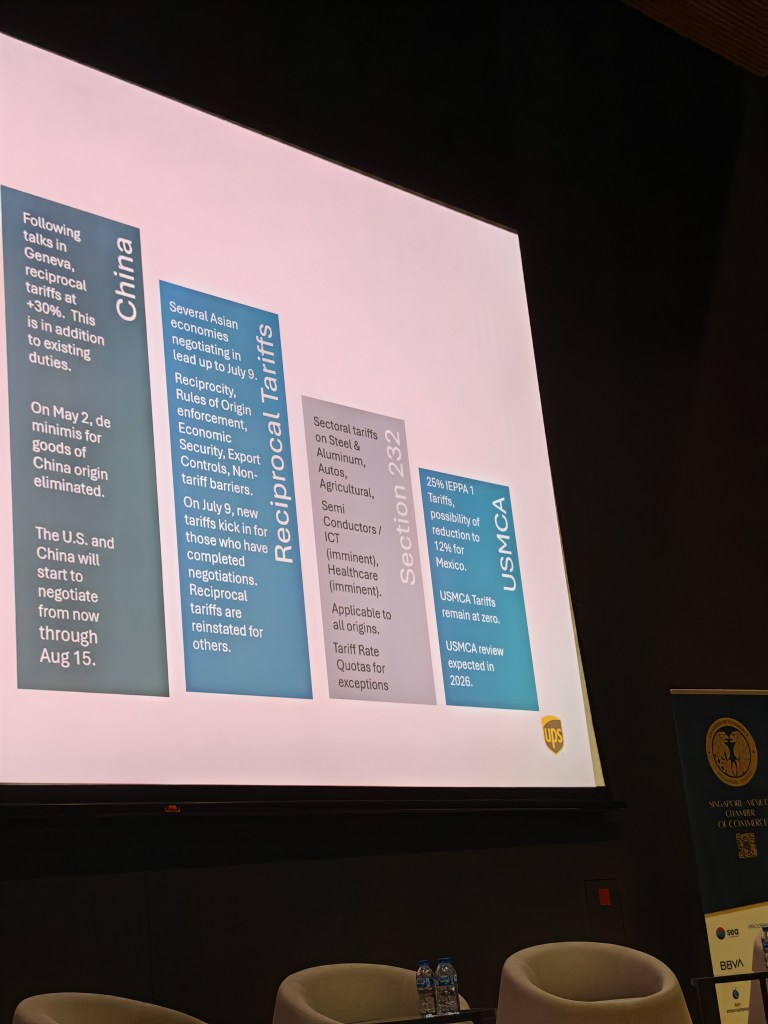
I found this slide interesting. This slide was based on takeaways from a talk by a US Ambassador as to what the US was looking to achieve via tariffs.
a) reducing dependence on China, b) increasing revenue via tariffs to reduce the deficit and c) enhancing supply chain resilience and economic resilience in certain strategic sectors.
There will also be greater enforcement of rules of origin.
And there are certain identified sectors which will face tariffs as the plan is to to either have these manufactured in the US or very near the US. These sectors include pharmaceuticals, semi conductors, ICT, steel, aluminum, autos and agriculture. The high tariffs imposed on import of goods from these sectors is to push the eventual manufacturing of these products to the US.
And the current thinking is that a baseline of 10% tariffs will be the norm.
All this will have a huge impact on Singapore. All our exported goods to the US may face a baseline 10% tariff, up from the current 0%. Also we are large exporter of pharmaceutical products, semiconductor and ICT products to the US. These sectors contribute a significant amount to our GDP and provide employment to a large number of people here. If the US wants to near shore these sectors and impose high tariffs on imports there, at some point in time, companies may decide to uproot from other countries, including Singapore, and instead manufacture in Mexico, Canada or in the US.
Mexico currently is in a strong position because of the existing USMCA, which will be in force till 2036. Negotiations to extend this are currently underway. Under the USMCA, for qualifying goods there are no import tariffs, provided that the goods are wholly obtained or produced entirely in Mexico or it undergoes a significant transformation in Mexico.
I can see why Mexico is currently in the limelight and is attracting so much interest from manufacturers.
And I can also understand why Singapore is very concerned about the current situation. What do we have to offer to avoid general tariffs and specific industry tariffs? Why would the US treat us as an exception to their current philosophy? Can we find other markets to export to to take up the US slack?

 daily musings