Author: CMR.sg

  • European Migration

    I was surprised to learn that in Sweden, which was once a quiet and successful European country, and of course home to ABBA, there are now bombs going off regularly planted by gangs. About 30 explosive devices went off in a month with the police having foiled an equal number.

    The gangs use explosives to extort from businesses, restaurants and hotels. Extortion aside, they are numerous other gangs which are engaged in the drugs trade.

    This was shocking. Imagine explosives going off in the middle of the night set off by armed gangs which are also peddling drugs and creating a huge social problem. How did Sweden get to this stage?

    Sweden was in the forefront of migration in the early 2000s. Now the number of foreign born living in Sweden stands at about 20% of the total population. Most of them are from the Middle East or Africa and mostly Muslims and poor. Integration of this group with the existing Swedish people has been a serious problem. My own view is that complete integration is an almost impossible task. They are racially and religiously different. How can integration be possible when there is such a vast difference between them as peoples culturally, racially and religiously.

    They were allowed in on compassionate grounds, which speaks volumes for the generosity of the native Swedish people. It also made economic sense then as the population growth rates in Sweden and in the rest of Europe were declining and they needed an infusion of younger people to do the work that the Swedish people either didn’t want to or couldn’t do.

    But the numbers blossomed uncontrollably and now, these new migrants form a large part of the gangs which are creating serious problems in the country. I can imagine how angry the native Swedish people must feel about this. Talk about biting the hands that have fed you.

    Meanwhile in the UK about US$ 5.4 billion is spent annually on asylum seekers. At a time when the country is struggling to keep its NHS afloat and maintain its basic infrastructure which is falling apart, this huge amount of money is spent on people who have come into the country, some illegally, for their housing and food. Many again are from the Middle East, Africa and Afghanistan. Integration again is a problem. It’s just that in the case of the UK, there is already a large Muslim population present.

    Resentment is rife in Europe and there is growing anger towards migration and to the people who have come in.

    But what can be done? Deport them? Their numbers are huge and a large proportion of them now have visas to stay in Europe. The birth rates are also higher for the migrants and so in about 30 years, they may well constitute the majority in Europe.

    In the US, Donald Trump won the election on this issue alone and is taking steps to deport illegal immigrants, with huge support from most Americans.

    Is Singapore immune to all this? We have brought in people from other countries. In our case most of them are either wealthier, well educated, younger and/or professionally qualified. So we end up having a different set of problems. We have migrants who can afford to have a better life, own properties or do better jobs than our local people in many cases. They are generally not the ones who cause any law and order problems. They are also net positive contributors to the economy and they come in legally and in numbers that do not affect the existing racial mix. How do you keep our locals happy in this kind of migration?

    Not having immigrants may not be an option for us. Our local population is declining, ageing and there is a need to maintain and grow our numbers to keep the economy going and support an ageing society.

    But how do we avoid the kind of backlash in Europe and in the US? Better integration? If so how? Even if efforts are made at this, how effective can this be? How do you ensure that migration does not antagonize your local people and avoid the current backlash in Europe and the US.

    Perhaps being wary of and opposing people different from us or outside our space is a matter of instinct and hardwired into our brains because of how our  predecessors were. We were a tribal people. We lived, ate and died as part of a tribe. Being part of a tribe was essential to our survival. Belonging to a tribe to the exclusion of others may  well always be a part of our DNA. Excluding others outside the tribe ensured that the limited resources would always be available to the tribe to continue it’s existence. Being territorial and unwilling to accept and share with outsiders may well be inborn in us. Can we overcome our ancient upbringing?

  • Mei Ling’s Birthday Dinner

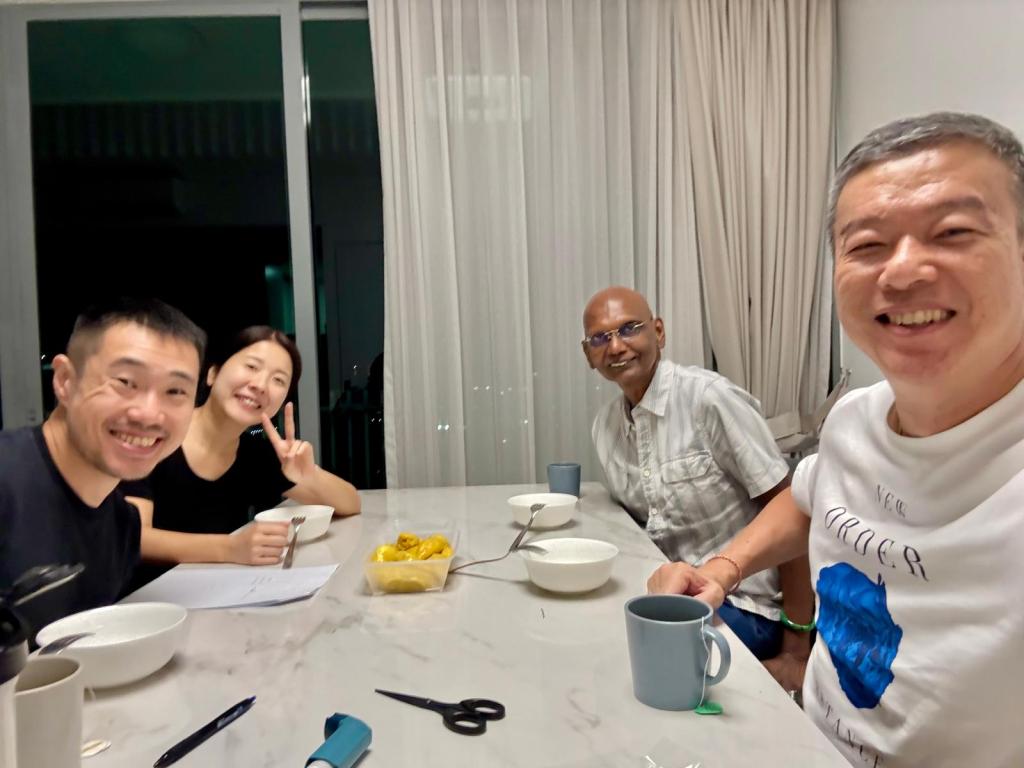
    Last night was Mei Ling’s birthday dinner.

    We celebrated at Bold Thai at Capitol Piazza.

    The food was good although I didn’t eat much. I think I have been eating too much recently! The place was a bit noisy though.

    Again we have been doing this as a group for some time now and we know each other well since our North West Community Development Council days. It’s always enjoyable when we do catch up at these birthday dinners as we don’t meet much otherwise.

    We didn’t have much conversation except for that of the upcoming elections. The ambience and noise outside may have had something to do with that. Unfortunately I had to leave by 845 as I needed to meet up with a friend who needed some help.

  • Lunch with Ashwini Kumar

    Had a wonderful lunch today with Mr Ashwini Kumar, who is the Head of Chancery at the Indian High Commission. A last minute arrangement and am glad we both found the time to catch up. We met at Anglo Indian restaurant at Chijmes.

    We spoke about the US India trade tensions. India has a $100b trade deficit with the US. This is created primarily  by the export of pharma, steel, aluminum, engineering goods and electronics to the US. Unfortunately there are very few things for India to buy from the US. The way out may be for India to purchase oil. Strange. I always thought that the US was dependent on oil, especially from the Middle East. It was the squeezing of oil supply by the Arab nations in the 1970s which led to a huge recession in the US and Europe. Now they are in a position to export oil to other countries. Amazing.

    I wonder if the US was not such a consumer oriented society whether it would have such a large trade deficit with many countries especially China. Also the US stopped manufacturing products some time back because it was much cheaper to make them in low cost countries. Why would one now want to purchase more expensive products made in the US when you can purchase the same or better quality prices made elsewhere cheaper? What does it have to sell to the world apart from arms?  Even then not the latest technologically advanced ones? It does well in services but that is sold by US based companies like Apple, Microsoft, Google and Amazon. I wonder if that counts towards the deficit accounting?

    We talked about Singapore and India, its relations, connectivity, people and trade.

    We briefly spoke about the politics of India and Singapore.

    We also talked about the mainstream media reporting of events in India, in particular that of the recent world chess championship held here.

    Finally good to know the High Commission is organizing a biryani festival in May!! Looking forward to that!

  • Shang Dinner and Recalling Noris Ong

    Tonight, once again, was our quarterly dinner at Shang Palace. This dinner group started some 5 to 6 years back. We all had served in the ACS Old Boys Association Management Committee at different points in time but we got to know each other and became friends. Victor Chia was President from 1998 to 2000, Chelva Rajah was President from 2000 to 2004, Ang Peng Tiam was President from 2004 to 2008 and Benson Puah was President from 2008 to 2012.Jen Howe was the treasurer for some of the years. Mildred Tan was a committee member for a while and I served as the Secretary for all the 4 Presidents.

    We are not from the same cohort in school and I didn’t them until I worked with them in the Committee. Having worked together, we became friends over the years. I cannot now remember the impetus for making this a regular dinner session. Neither can I recall how the people in this group came to be identified or who picked them.

    I started serving in the Management Committee in 1992. I was asked to join by David Wong. Other than David, I didn’t know anyone else in the committee. All of them were much older. David was the Vice President. He held the fort for 2 years from 1992 to 1994 and then handed it to Noris Ong, his classmate.

    Noris Ong was the first President I served. A wonderful man and I have very fond memories of him. He had worked in London and was one of the youngest partners in Coopers and Lybrand, a prestigious accounting firm. He was talented. He could sing well with a lovely low voice and play the guitar. He was a Nominated MP for a while. He was generous and would take out the entire committee for dinner at the Tangling Club, where he was a committee member, after our meetings. He would pick me up from my home and we went to football games at the National Stadium and for supper. He would send me back although he wasn’t living near my place. We went on a yacht, owned by Coopers, a few times. I have been to his home many times, knew his wife Betty and his 2 young boys. We also went to karaoke a few times because he loved singing. Around 1995, the Barings episode happened and Coopers was unfortunately dragged into law suits here in the UK later. It eventually ceased to exist as a firm and was absorbed by Price Waterhouse. I think Noris, who was the head of tax at Coopers, didn’t fit into the Price Waterhouse culture and he retired soon after. We grew apart in the early 2000s. I didn’t see him or speak to him for sometime. We then started talking again around 2007 when he called me and wanted my advise on a community project he was involved in. In 2008 I met him and his wife at an ACS dinner. He was seated at a different table. At that dinner  Ang Peng Tiam, an oncologist, was describing symptoms of colon cancer. For some reason Noris became concerned and immediately went for a scope. He was diagnosed with a stage 3 or 4 colon cancer. He survived a year and passed away in August the following year in 2009 when he was just 60. Sad.

    We each take turns to host our current dinner. We talk about anything that has happened to us, Singapore or in the world. Something to look forward to. Let’s see how long we keep it going

    Back row Peng Tiam, Mildred, Benson and Jen Howe Front row Chelva. Myself and Victor

    Tonight’s Shang dinner was hosted by 4 of us who had said that Kamala Harris would win the US election. By now we know the results and we had to host the ones who picked Donald Trump.

    The 1992 Management Committee

    A picture of the very first Management Committee I served in the ACS OBA.

  • Inheritocracy-Economist

    I read the Economist every week. I have tried to make this a habit although trying to finish each issue before the next one comes out in a week’s time is not easy. But it’s well worth the effort. I learn a lot from the articles although I may not always agree with their point of view on everything.

    So this week’s leader was this article entitled Inheritocracy. This is about how a group of younger generation will inherit the wealth accumulated by their parents. The wealthier the country, the more the young there would inherit.

    The magazine argues that this will create problems. For one it will create a class of people who will accumulate and hoard their wealth to pass on to their children and not put it into productive economic uses. The bigger problem, and the one I think is serious, is that of an underclass of non-beneficiaries who will be left far behind especially in relation to owning properties. This is especially true when property prices are increasing at a rate far greater than that at which salaries are increasing Properties may become out of reach of a large majority without any inherited wealth. This group will become disaffected and have little or no incentive to work hard as the opportunities to have a comfortable life are becoming increasingly stunted.

    I tend to agree with this. I did not come from a wealthy family but my parents worked hard to give me a good education. Through a good education and hard work, I was able to reach a certain comfortable level in my life. There was an incentive to study and work hard because you knew that through that you can own a decent property, car, comfortable holidays etc. I think this was also the case for most of my friends and colleagues in that age group.

    I worry that the social mobility I had is disappearing in today’s society. True you may have a HBD roof over your head and good public transport so that there is less need to own a car but how much further can one beyond these when you are competing with inherited wealth.

    So yesterday, a good friend called me at 6 in the morning. He wants to purchase a $8 million apartment for his grandchild. His sons and daughters are already taken care of. Imagine being aged 2 and already owning a property which has a current market value of $8m. What will be the value of that property when his grandchild reaches 21. I understand many wealthy people have started purchasing private properties for their children.

    Then this morning, another friend was talking to me at the gym and she, after much homework and planning, is sending her son to a top boarding school in US. This is a 4 year program and it apparently puts one in a very good position to get into a good Ivy league University thereafter. It costs about US80k a year, excluding the travelling expenses. Of course when you get to a boarding school like this, you get a head start not just with your University education but also with the connections you make with all these otherwise connected families who can afford to send their children there. And this is not an isolated case. She tells me all her friends have either sent or planning to send their kids to such boarding schools.

    So I wonder and worry what will happen to good, clever and hardworking children when they finish their education here. How will they compete with this other group of people and will they become disillusioned if they see this huge disadvantage they are already at?

  • Gordon Grill

    My lunch today was at the Gordon Grill hosted by Andre Yeap.

    I haven’t been there for about 3 years. The last time I was there was with Sitoh during Covid.

    The set meal is good and reasonably priced but there were only 2 tables occupied for lunch. Luckily the restaurant belongs to the hotel so they need not worry about paying rental. Otherwise they just will not survive. And the lack of diners is probably because of the location. It is too far from town and too far to walk from any MRT station. And the car park is just too expensive. For a 2 hour lunch, I paid $15. Ridiculous.

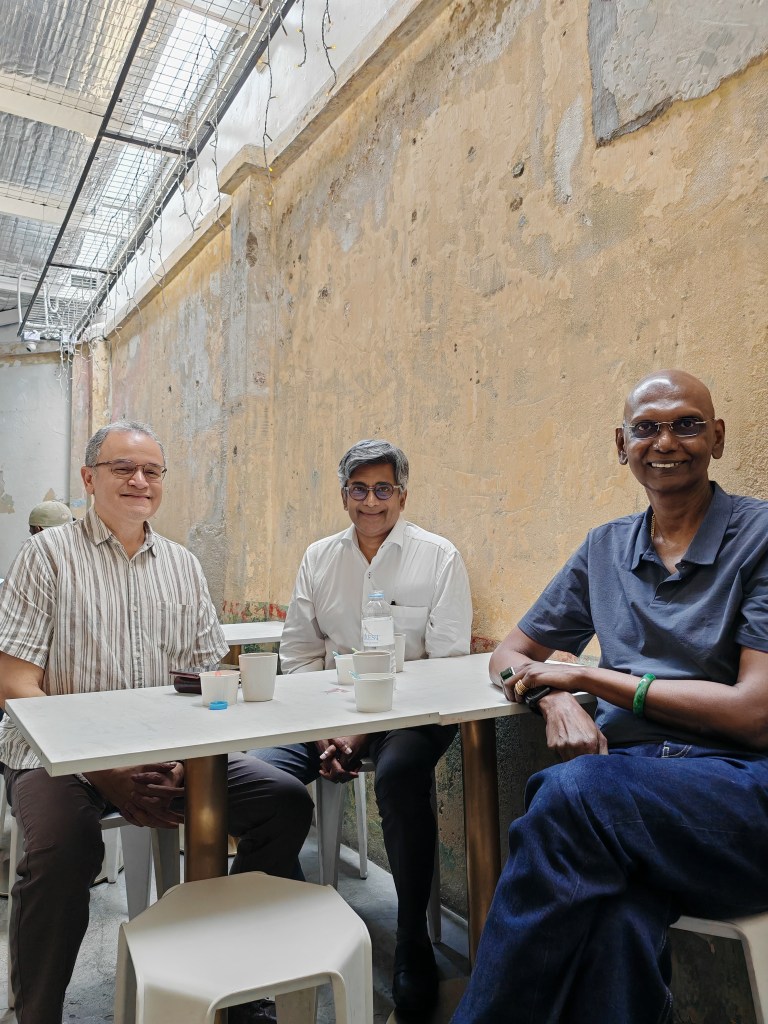
    There was good conversation with a nice bottle of wine. We have much in common as all 3 of us have been colleagues for many years. Usually I don’t drink but I made an exception for this good bottle of wine and so I had a small glass. During lunch we realized that all 3 of us were from the same secondary school.. different years.

    Andre and Harish

  • Ex Offenders

    I met an ex offender today who needed help. He managed to find employment and his employer wanted to pay his salary into a bank account. He opened an account but almost immediately, the bank closed it without providing any reasons. Presumably they found out he is an ex offender.

    It’s sad that for an ex offender, so many doors are closed to them. Despite all the talk about rehabilitation,they have difficulties finding employment and being accepted by family, friends and society. They are of course cases where if a bank opens an account for them, they are misused accounts and some for criminal purposes. But having a bank account is critical in today’s life? With everything going cashless how are they going to live and pay for things in today’s world?

    I do hope that banks take a sympathetic case by case approach to help them on their path to rehabilitation.

    .

  • Calvin and Hobbes

    Today I received my 4th volume of the Calvin and Hobbes Compendium. This is supposed to be a 7 part series and I am waiting for the last 3 volumes to complete this collection.

    Calvin and Hobbes is very special. It was the first comic I read as an adult. Of course when I was younger I read the usual Archie, Beano, Snoopy, Mad magazine etc. I then stopped reading comics, probably from about the time I was in secondary school.

    When I was working in the University, a colleague, Mary Wong, recommended Calvin and Hobbes to me. I had never heard of this book before and she urged me to read it and lent me her volume. This must have been around 1991/92.

    I was so fascinated by that 1st volume and I remember asking her where I could buy it. She recommended me a comic shop (that no longer exists) somewhere near Centerpoint. Thereafter I followed up and read all the available volumes and all that came thereafter.

    It tells a touching story of a 6 year old boy, Calvin, and his toy tiger, Hobbes, who is a toy to everyone except Calvin. It tells in a very funny way how both see the world and their interactions with adults and other kids.

    It is difficult to put into words the effect each comic strip will have on you, and like Mary Wong did to me, I will just urge you to try it.

    What was so interesting is that the author Bill Watterson was so frustrated by the commercialism in the comic book industry that he stopped writing the comic after 10 years. So this comic ran from Nov 18 1985 to Dec 31 1995. He also did not allow any merchandising of his comic strip. So unlike every other comic, you will not find prints, toys or games for Calvin and Hobbes. He also did not allow his comics to be put into any other media form and so you will not find cartoons or movie versions of this comic.

    So I have pieces signed by Charles Schulz and Hanna Barbera of their comic or cartoon characters but nothing by him, except the book itself.

    I can imagine the strength and the integrity involved in him giving up these opportunities to make money. One estimate puts it at about 300 to 400 million dollars that he gave up by not allowing commercialisation. He is apparently living a quiet life with his family, content with the work he created. He did not do any more comics after that.

    I have collected all of his books, including a limited edition hardcover copy.

    Do go and read it. A wonderful read!

    My 4th volume
  • Singapore Indian Fine Arts Society

    Tonight was the golden jubilee celebrations and fund raising dinner of SIFAS. It was a last minute invite by DBS to sit at their table. I didn’t know anyone at the table and no one appeared to be talking at that table. All in all a rather boring table.

    I have come across this society when I was growing up. Perhaps my sister took some dancing lessons there when she was very young? Or I attended their concerts?

    They conduct Indian classical music and dance lessons and over the years many students have gone through their doors. They arrange performances for their students and teachers and performances by artists from India. One in particular was by the legendary late U Srinivas.

    Tonight’s dinner was at Global Indian International School at Punggol. I have not been to that area but it was a huge and impressive campus. The event was graced by President Tharman who gave a short delightful impromptu speech.

    The opening performance was so so and a bit too long. Pity. Perhaps it was the sound system? The food was only average. Sounded fancier on paper than how it actually tasted.

    Traditionally the arts have always been the domain of the well to do. They had the time and money to indulge in it and they could encourage their children to learn and practice the arts. With their wealth, they have also been the patrons of arts and culture. To a large extent the arts have been kept alive by them, to which we must be grateful.

    I do however hope that they  can reach out to more Indians in Singapore, especially those who are not well off. I accept it is difficult to indulge in arts and culture when you are trying to earn a living just to make ends meet and feed the family. But it would be a pity if the younger ones don’t get the opportunity to at least learn or even know a bit of the arts and the culture that they belong to.

    The video of the history of the society showed that it was started by some well off Indians who wanted their sons and daughters to learn Indian classical music and dance. Their children and grandchildren have continued this tradition. The expat Indian community, which is generally better off, was well represented at the dinner and many of their children are probably the ones who participate in these classes. Not sure how many Indians outside of this group participate in their activities and how welcoming they are of them.

    I thought it was a pity that the society, which has  lasted 75 years, didn’t acquire premises of their own earlier when properties were affordable so that they have a permanent home. They are still leasing premises from the Government on short term leases.

  • Photo of Tamil School Teachers

    My neighbor called me and excitedly informed me that she found an old photo which had my father and her father next to each other. I went over to look and indeed my father was in the picture. I later confirmed with my mother that this was a photo probably taken some time in the early 1960s. All of them in the photo were either tamil school principals or teachers together with 2 inspectors for tamil schools. This photo was taken in the bygone era when there were Tamil schools catering to the Tamils in Singapore. There were numerous primary schools all over the island and one secondary school, which was the Umar Pullavar Tamil school.

    My parents were both tamil teachers. My father was a teacher at Kalaimagal Tamil school from 1955 to 1960, then a principal at Barathithasan Tamil school from 1960 to 1974, when the school shut down. My mother was initially a student at Sarathadevi Tamil school for a year. She then did her teachers’ training, which in those days was conducted in Johore Bahru on a Saturday and became a teacher at the same school. She then moved to Umur Pullavar Tamil school. Thereafter tamil schools in Singapore ceased to exist and all the tamil teachers became tamil second language teachers in English medium schools.

    I remember waiting for my father at his school which was at the Henderson/Alexander area. It was a single storey building with one classroom per level. There used to be a big field next to the school. On the other side was a dispensary/clinic. It was surrounded on all sides by city council houses, which were single level houses.

    My mother’s school was at Norris road and I remember waiting with my father for her school to finish to pick her up. Sarathadevi Tamil school was at the end of Norris road. At the front end of Norris road was Vivekananda boys school.

    I recognised some others in that picture. Some of them were my Tamil teachers in primary school.

    During my primary school days from 1969 to 1974, my school did not have tamil teachers. So those taking Tamil as a second language had to attend classes on Saturday mornings from 8 am to 1 pm. Tamil teachers from other schools would come to my school on that day to teach us. I remember my own father going on Saturdays to Pulau Blakang Mati (now Sentosa) to teach Tamil at a school there

    From L to R back row

    Mr Varathappan (my teacher), Mr Duraisamy, Mr Balaiyah (my teacher), Mr Pavadaisamy (my teacher), Mr Steven Manikam, Mr Kesavan (my neighbor’s father), Mr Rathinam (my father), Mr Selvaraj, unknown, Mr Thangaraj.

    From L to R front row

    Ms Parvathy, Mrs Florence (my teacher in JC), Mr Karupayah, unknown, Mrs Chelliah, Mrs Krishnaveni

    Sadly everyone in the picture haa since passed on.-(