Author: CMR.sg

  • Shangri la Dialogue

    An annual event at the Shangri la involving defence personalities which has now become an established calendar event.

    It’s good that a small country like Singapore can be a host to such a large important gathering of importing people around the world to discuss regional defence and cooperation.

    47 countries are represented, mostly with their defence ministers or head of armies. Malaysia is represented by its PM and France sent it’s President. US is well represented with their Secretary of State for Defense and all their regional military heads.

    China sent only a Rear Admiral. Either they think the event is not important or its not worth their while participating at a higher level. Of course, not surprisingly, the US made fun of their absence of anyone with gravitas.

    The message the US has for the region is similar to that it has for Europe. Spend up to 5% of your GDP on defense so that you are equipped to deter China. It is committed to the region and it wants to keep China’s aggression at bay but it wants the region to participate together with it by upping their own defense spending as only that will deter China. The US cannot do it alone. The very fact that such a strong delegation from the US turned up is clearly a sign of their commitment to this region, I believe.

    The idea of such events is to get the right people to gather around and hear each other’s viewpoints and talk. Getting to know each other improves the points of contact and communication between people. After all communications between people can be useful and illuminating.

  • Stone Slabs for Shaista Mahal

    I just finished reading the first story in Banu Mushtaq’s Heart Lamps which won this year’s Booker Prize.

    The author is a 77 year old Muslim lawyer activist and she writes in Kannada, a South Indian language. The book was translated into English by Deepa Bhasthi.

    The book is a collection of 12 stories she has written over the years.

    She is known to champion women’s issues in particular that of the South Indian Muslim women and their struggles..

    I have only read the first story so far. A simple one. Nothing profound. But it sets out some of the issues that these women encounter in their daily lives.

    In the story one of the issues raised was the prevalent thinking of the status of a wife vis a vis her husband. How to a wife no matter how much she serves her husband, she will never be able to completely repay the debt she owes him. She is supposed to be his most obedient servant and his bonded labourer even if he is a drunkard, womaniser or abusive.

    It then raises the issue of husbands expecting their wives to bear as many children as possible. In this story, the lady already has 6 and is expecting the 7th one. She desperately wants to stop so that she can look after her existing children well and do other things in her life but the husband is not in favor of this. She desperately wants to have an operation to sterilize herself but the husband protests.

    It talks about how fathers do not think it is necessary for their daughters to be educated beyond secondary school and want them to be married off young. This is despite the mother wanting her daughter to be educated and be a graduate and have a career instead of marrying young.

    It discusses the status of a daughter which is almost akin to that of a servant at home. She cleans, cooks, looks after her younger siblings and tends to the needs of the parents.

    There is discussion on the status of a wife and how a wife can do easily be replaced. And in this story the husband remarries immediately after his wife dies.

    All this from the first of 12 stories. But these are real life issues women face in certain societies. Although she writes from her own perspective and her experiences with Muslim women, I think these issues are common to most women in India, especially those from the rural areas.

    Winning the Booker Prize will certainly create a wider audience for her work. The book was sold out in our local book stores. Hopefully this wider audience reading her work creates a greater discussion of these issues and perhaps solutions to some of these issues.

  • Tariffs Torpedoed…for now…with updates

    A US Federal Court, the Court of International Trade, has by a 3-0 ruling, held that the tariffs introduced by Trump are illegal and unconstitutional.

    They ruled that the power to impose tariffs belongs to Congress only and that President cannot use the argument that he is acting under an economic emergency to introduce tariffs unilaterally.

    The tariffs that were struck down are the fentanyl tariffs that were introduced as a punishment on China, Canada and Mexico and all of the tariffs introduced on “Liberation Day” and the 10% universal tariffs on all countries.

    Where does this go next? I am sure this will end up in the Supreme Court eventually. In the meantime do countries negotiate tariffs with the US or wait it out for the final outcome? And if the Supreme Court upholds this ruling, would Congress, which is controlled by the Republicans act to impose similar tariffs? Also the power given to the President to impose tariffs using s.232 remains untouched as that was not challenged. This was the power to impose tariffs on sectors such as semiconductors, pharmaceuticals etc.

    The uncertainty continues…

    PS

    The appeals court has now allowed the tariffs to remain in place pending an appeal.

    A strange situation where the tariffs are in place and the US government is collecting revenue and negotiating trade deals on the basis that the promised tariffs will kick in if a new trade deal is not reached. What if the final court of appeal upholds the decision of the court below? What will happen to the revenue collected so far? Should a country continue negotiating with the US on the basis the the threatened tariffs will kick in or take a chance? Difficult decisions…

  • Navigating Trade, Tariffs and Supply Chain Shifts

    Today I attended this seminar organized by the Singapore Mexico Chamber of Commerce. This seminar was the one we decided to organize to address the current tariff uncertainty created by Trump.

    It was well attended and there was one session that I found very useful.

    I found this slide interesting. This slide was based on takeaways from a talk by a US Ambassador as to what the US was looking to achieve via tariffs.

    a) reducing dependence on China, b) increasing revenue via tariffs to reduce the deficit and c) enhancing supply chain resilience and economic resilience in certain strategic sectors.

    There will also be greater enforcement of rules of origin.

    And there are certain identified sectors which will face tariffs as the plan is to to either have these manufactured in the US or very near the US. These sectors include pharmaceuticals, semi conductors, ICT, steel, aluminum, autos and agriculture. The high tariffs imposed on import of goods from these sectors is to push the eventual manufacturing of these products to the US.

    And the current thinking is that a baseline of 10% tariffs will be the norm.

    All this will have a huge impact on Singapore. All our exported goods to the US may face a baseline 10% tariff, up from the current 0%. Also we are large exporter of pharmaceutical products, semiconductor and ICT products to the US. These sectors contribute a significant amount to our GDP and provide employment to a large number of people here. If the US wants to near shore these sectors and impose high tariffs on imports there, at some point in time, companies may decide to uproot from other countries, including Singapore, and instead manufacture in Mexico, Canada or in the US.

    Mexico currently is in a strong position because of the existing USMCA, which will be in force till 2036. Negotiations to extend this are currently underway. Under the USMCA, for qualifying goods there are no import tariffs, provided that the goods are wholly obtained or produced entirely in Mexico or it undergoes a significant transformation in Mexico.

    I can see why Mexico is currently in the limelight and is attracting so much interest from manufacturers.

    And I can also understand why Singapore is very concerned about the current situation. What do we have to offer to avoid general tariffs and specific industry tariffs? Why would the US treat us as an exception to their current philosophy? Can we find other markets to export to to take up the US slack?

  • Ancient Religious Practices

    I was reading a book, A history of Religious Ideas by Mircea Eliade. This book is a massive undertaking by the author and is a very detailed historical study of religion and the various religious practices from the very beginning of the human race.

    It was one aspect of the book that hit me yesterday. Almost all of the ancient religions from Sumerian, Babylonian, Egyptian and Indus civilizations seemed to have had certain uniform beliefs and practices. This is despite the fact that there is no evidence of any direct connection or communication between these civilizations and so its not clear how they all came about to have these very similar practices. Unless of course all of them derived these from a prior single common source, a civilization that existed prior to the Sumerians and which had spread out to all these other areas, of which nothing is known.

    The commonality appears to be the existence of multiple gods of different hierarchies often representing different domains such as the sun, wind, rains etc with the existence of a superior god. Fights and competition between gods are fairly common, gods marry humans, the praying and giving of offerings to idols who represented the gods, the building and importance of temples, the significance attached to a king who was seen to represent to gods on earth, the regular cleansing and renewal of temples, animal sacrifices, celebration of an annual harvest or new year festival signifying rebirth and refresh. All of these practices appear to be common to all these early civilizations.

    The modern religious, however, such as Christianity and Islam have by their religious teachings effectively abolished these early practices. Christianity developed about 2000 years ago and Islam some1400 years ago. Both these religions preached the existence of only a single God, no idol worship and have downplayed the role and importance of temples. Buddhism, the other major religion, doesn’t believe in a god at all.

    Something then hit me when I recalled my recent trip to India when I visited some temples.

    All these ancient practices which were in existence some 6000 years ago are practiced in full force in South Indian religious culture.

    They have multiple gods of differing levels people pray to and they also have their superior gods namely Shiva and Vishnu. They pray to idols, who signify their gods. Temples are revered and temple ceremonies play a very important role in the lives of the people. Temples are regularly cleansed and temple consecration ceremonies are very important occasions. Harvest and new year festivals are still important religious events in their lives. There was a particular temple I visited, the Alagar temple in Madurai, where animals are sacrificed outside the temple grounds to honour and give thanks to the gods and the entire family and relatives gather to then cook and consume the meat of the sacrificed animal.

    I found it amazing that almost all the practices that existed more than 6000 years ago are still in existence today in full force. How did this continuity come about? Or is this something innate in humans I wonder?

  • The Great Indian Biryani Festival

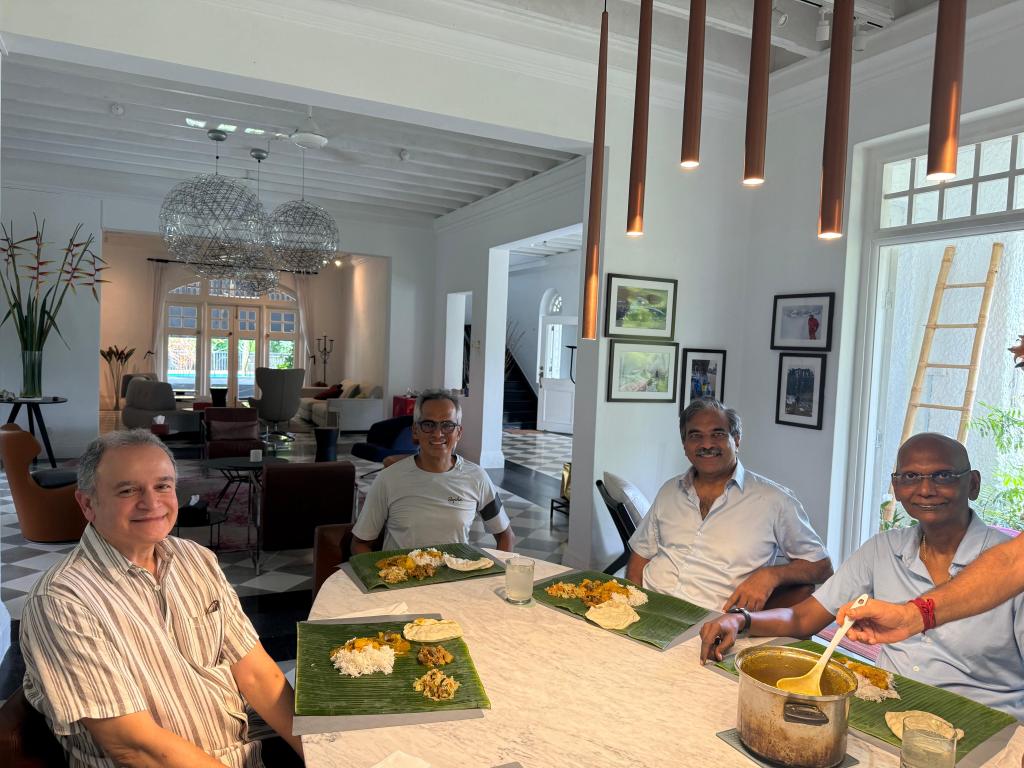
    This was an event organized by the Indian High Commission at the Shangri la Hotel and was held over 3 days.

    I decided to have lunch here with my mother today.

    There were multiple varieties of biryani. At least 10 different varieties with lots of Indian curries, vegetables and desserts. And a live appam station. The biryanis were good and there was a dindugal mutton biryani and a Kolkata egg and goat biryani that was exceptional!

    I was pleasantly glad to see that it was very well patronized.

    I met quite a few people I know as well at this event. I met Ashwani from the HC. He was there with his family. I saw Prasoon and also Wendall Wong. And my mother. bumped into an old student of hers at Christ Church Secondary School.

  • Careless People

    I just finished reading Careless People by Sarah Williams.

    I came across her when I saw her giving testimony before the Senate sub committee hearing re Facebook, the now Meta, on Youtube. I then found out that she had just recently written this book and so I purchased this as I wanted to know more about what she had to say about Facebook. She was at one time its director of global policy.

    This book is about her 7 to 8 years in Facebook. It starts out with how she enthusiastically pitches for a job in Facebook to do policy work for them in dealing with governments. The energy, drive and passion she had in getting governments to harness the potential of Facebook in the early years and how it completely slides into disillusionment, disbelief and disgust at how Facebook subsequently morphed and her eventual firing.

    I was fascinated to read about the role Facebook played in the 2016 election win by Trump, which was at that time completely unexpected. The book describes in some detail the tools the Trump team used to reach out to people and spreading fake and misleading news, the targeting of specific groups with specific messages, identifying ideology and leanings of people by looking at their posts and friends and reaching out to them with specific messages.

    After this election, Mark Zuckerberg and his key people realised the potential they held in their hands to be able to manipulate and influence in outcomes and elections. They were then feted by leaders who wanted to keep Facebook on their right side because they knew that they too could use it to keep themselves in power.

    A large part of the book deals with China and how Mark Zuckerberg and his key people desperately tried to get Facebook into China by offering numerous concessions and even access to data of users in other countries to the Chinese government. To appease the Chinese government, they blocked sites of overseas Chinese dissidents and they lied to the US authorities about the extent of their involvement with the Chinese Communist Party. And all this was because to Mark Zuckerberg, China was a huge market where he saw the potential to make a lot of advertising money.

    Another section of the book deals with Facebook’s pitches to advertisers on how they can sell targeted ads because their algorithms allow them to monitor their users. One specific example was targeting young vulnerable girls, who deleted their pictures. This would alert Facebook advertisers to push to them beauty products. I found this repulsive. And I don’t think people who use this social media platform realise that all their activities are monitored for monetisation purposes by Facebook.

    The role Facebook played in the genocide in Myanmar is set out in some detail. Facebook was used extensively to spread fake news in 2015 and 2016 in Myanmar and this contributed to large scale killings of Muslims in the country. The role of Facebook in promoting the killings is also set out in the UN report on the genocide. Of course, despite being alerted to the extent of fake and misleading news and the effects it was causing, Facebook did nothing to take it down.

    After having read this book, I am genuinely concerned about the power some of these social media apps and platforms such as Meta and Google have in people’s lives. The people running these organisations are no angels and actually I did find some of the personalities in Facebook detestable. They are in it to make money out of their users in any way possible and they are going to bend and break rules to make it happen for themselves. How do individuals protect themselves from these tech giants who are well aware of all the social ills their products are having on people? Can we depend on governments to do it for us, when these very same governments are working with these platforms to protect themselves or get them to set up HQs and data centers in their countries? Apart from the potential harm to the individual, how do we prevent or control the potential harm social media apps can have in dissemination fake and misleading news and inciting hatred and riots and even manipulating elections?

  • Violet Oon Lunch

    Today’s lunch was with a good friend at Violet Oon restaurant at Dempsey. He choose this place and he decided to play host.

    This restaurant has just opened at this location for the last one month. It wasn’t packed for lunch, about a third full. Not sure if their dinner crowd is better.

    The food is decent but I always thought Pernakan food is a glorified form of Malay food but with pork. We had gado gado, tahu telur, beef rendang, chicken curry and eggplant, all fairly typical Malay dishes. I think we over ordered and we were both kind of full after just the 2 starters!

    Typical of Pernakan food, I felt a bit bloated after lunch, probably due to the lemak in the food.

    Of course conversation with U Zyn is always good and we covered so many topics!

  • Another ACS Dinner

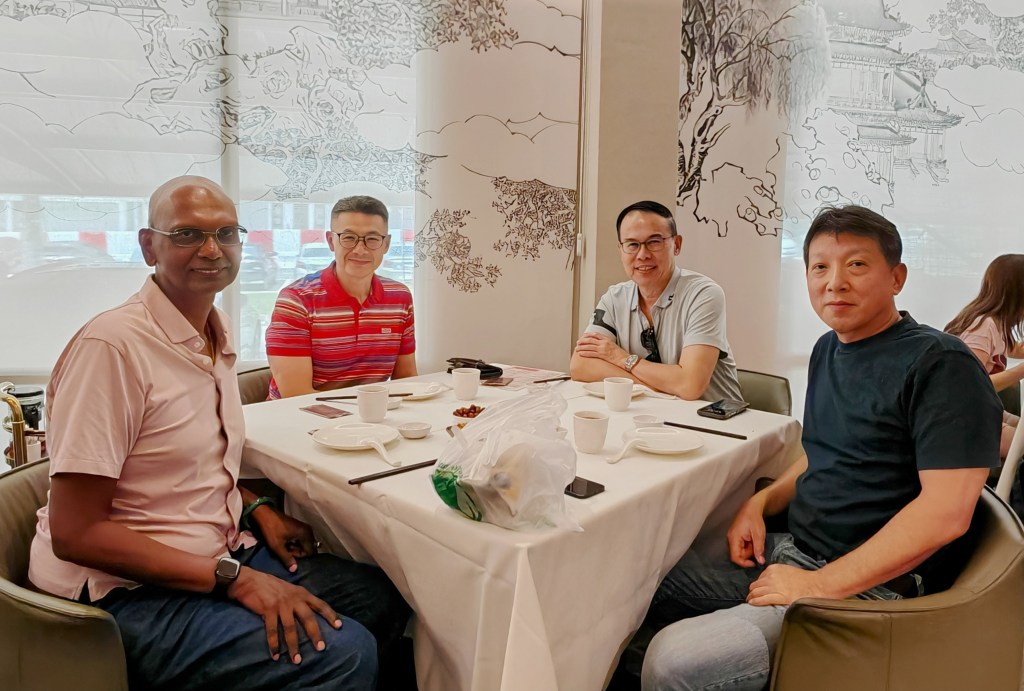
    Last night was once again the time for our ACS catch up dinner. This time it was hosted by Mildred Tan at Min Jiang Restaurant at Goodwood Park Hotel.

    As always the conversations touched a huge variety of topics. Elections, EVs, vaccines, the current state of the US, buying furniture in China, prices of medical devices in Singapore, good and reasonably priced food overseas etc.

    I was not too impressed with the food. Although it is a very well known restaurant, I didn’t think the quality was quite there. But that could be said of most restaurants here nowadays. Expensive without the accompanying quality and therefore not worth the money.

  • Drive back from KL

    I just got back from KL. I left KLCC at 10 am exactly with a 100% charge. I cleared Tuas checkpoint at 135pm with 14% battery left. I arrived home at 150pm with 10%. It was a very smooth drive with no traffic jams. And I didn’t stop at all. I think I went a bit faster than the last time and that might explain the higher drain on the battery. From a timing perspective, door to door this is probably faster. From a cost perspective, it is also cheaper. So long as I don’t get exhausted doing there drive.